The Kids Are Haunting Dead Malls and Honestly? We Support This Completely
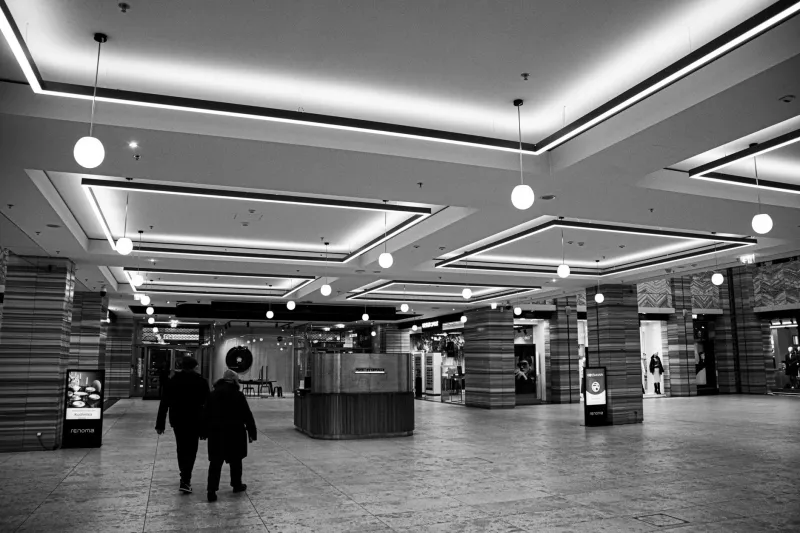
Somewhere in suburban Columbus, Ohio, there is a Sears that has been dead since 2018. The escalators don't move. The overhead lighting flickers with the particular existential desperation of a fluorescent bulb that simply refuses to accept its own mortality. The food court still smells faintly of Auntie Anne's pretzels, which is either deeply comforting or deeply haunting depending on your relationship with carbohydrates and the passage of time.
On a Saturday afternoon this past spring, approximately two hundred young people gathered in its parking lot for a pop-up zine fair, a vintage clothing swap, and a noise music showcase performed in what used to be a Things Remembered kiosk.
This is not a news story about urban decay. This is a news story about rebirth — specifically the weird, unglamorous, genuinely exciting kind that doesn't photograph well for Instagram because that's sort of the whole point.
The Dead Internet Has a Physical Address, and It's Off the Highway
If you've spent any time in the darker corners of online discourse — which, if you're reading Krokodil Droga, you almost certainly have — you've probably encountered Dead Internet Theory. The rough version: the internet as a genuine space for human connection and organic culture is already over. What remains is an elaborate simulation maintained by bots, algorithms, and the economic incentives of a handful of platform corporations, designed to look like a living, breathing cultural ecosystem while actually being a sophisticated mechanism for harvesting attention and selling it to advertisers.
You can debate the specifics. You can quibble about the percentages. But here's the thing that's hard to argue with: an increasing number of people under twenty-five are behaving as though they've already accepted the premise and are acting accordingly.
And where are they acting accordingly? In the physical ruins of the last cultural space that the internet actually killed.
The American mall, at its peak in the 1980s and '90s, was not merely a retail destination. It was a third space — somewhere between home and school and work where young people could simply exist without a predetermined purpose. You went to the mall to hang out. To see people. To buy a single CD and then sit on a bench for three hours talking about nothing. It was impractical and inefficient and basically impossible to monetize at the individual level, which is precisely why the internet eventually murdered it.
Now Gen Z is moving into the corpse, and they're redecorating.
Analog First, Questions Later
Meet Deja, twenty-two, who runs a risograph printing operation out of a former nail salon unit in a semi-abandoned strip mall in Richmond, Virginia. She prints zines, event flyers, and what she describes as "anti-content" — physical objects specifically designed to be unshareable online because they only make sense in person.
"Everything I make is intentionally bad to photograph," she says, gesturing at a stack of neon-printed broadsheets that look incredible in person and like a migraine warning sign on a phone screen. "If you want to see it, you have to come here. That's the whole thing."
Or consider the arcade revival scene, which has been quietly exploding in mid-sized American cities for the past three years in a way that mainstream tech media has almost entirely failed to notice because it doesn't involve an app. Barcades — bars with vintage arcade machines — have existed for over a decade, but what's happening now is different. It's younger, it's less ironic, and it's significantly less interested in alcohol than its predecessor.
In cities like Kansas City, Louisville, and Albuquerque, all-ages arcade spaces are opening in former retail locations, curated by twenty-somethings who grew up with PlayStation but are choosing to spend their discretionary hours playing Galaga in a room with strangers. The appeal, as described by virtually everyone involved, is almost aggressively simple: "You can't pause it to check your phone. You have to be here."
Fashion Week, But Make It Haunted
The sartorial dimension of this movement deserves its own extended meditation, but we'll give you the compressed version: the most interesting fashion happening in America right now is not on a runway, not on TikTok, and not being covered by anyone with a PR contact.
It is happening in pop-up clothing swaps in empty anchor stores. It is happening in the parking lots of dead Circuit Citys, where kids are laying out handmade and thrifted pieces on folding tables and trading them for other handmade and thrifted pieces with no cash involved and no Depop listing in sight. It is happening in the aesthetic language of what some participants are calling "mallgoth revival" — a reclamation of the Hot Topic-adjacent visual culture of the early 2000s, stripped of its corporate origins and rebuilt as genuine subcultural expression.
The key distinction, and the one that separates this from mere nostalgia tourism, is the explicit rejection of documentation. "Mallcore" fashion events — a term that's gaining traction in certain underground circles — frequently operate under informal no-posting agreements. You can take photos for yourself. You're asked not to upload them. The point is to have a thing that exists only for the people who were there.
In 2024, that is a radical act.
Why the Algorithm Can't Follow Them Here
The timing of all this is not coincidental. Gen Z came of age during peak platform capitalism — they were the first generation to have their adolescent social lives fully mediated by algorithmic feeds, engagement metrics, and the constant low-grade anxiety of being simultaneously performer and audience for their own existence.
The psychological toll of that is well-documented at this point. What's less discussed is the specific form the backlash has taken. This isn't a full retreat from digital life — most of the people building these analog spaces are still online, still have phones, still use the internet. What they're doing is creating deliberate zones of exception. Places and practices where the usual rules don't apply. Where you can't go viral because there's nothing to go viral with.
Dr. Shannon Mattern, a media theorist at The New School whose work examines the relationship between urban space and information infrastructure, has described this tendency as "infrastructural refusal" — a deliberate choice to inhabit and animate physical spaces specifically because they fall outside the logics of digital capitalism. "There's a long history of countercultures finding their homes in the discarded spaces of dominant culture," she noted in a recent lecture. "It makes a certain kind of sense that this generation would find theirs in the ruins of the consumer economy that the internet displaced."
The Actual Revolution Will Not Be Streamed
Here's what's genuinely exciting about all of this, and we don't use the word exciting loosely because we are a deeply cynical publication: it's working. The culture being produced in these spaces is weird and specific and largely invisible to the mainstream cultural apparatus precisely because it has no interest in being seen by it.
Zines that don't have PDFs. Bands that don't have Spotify pages. Fashion that doesn't have a hashtag. Events that you hear about because someone told you in person, which means you have to actually know a person, which means you have to have actually gone somewhere and talked to someone.
The dead mall, it turns out, is only dead if you were waiting for the Gap to reopen. If you walk in looking for something else entirely, it is one of the most alive places in America right now.
The fluorescent lights are still flickering. The ghost of Auntie Anne's still haunts the food court. And in the old Sears anchor space, someone is setting up a projector to screen locally-made short films to an audience of people who found out about it from a flyer stapled to a telephone pole.
Nobody is filming it. That's the whole point. You should have been there.